Okay, enough of beaches and motorbike pirouettes and wriggly worms for now. We haven’t really written about what we are here to do as VSO volunteers. So here’s the confession: Yes, we are working here. Quite a lot actually! I guess it’s time to give you a bit of content background on why we are out here, working in the health sector with no medical background whatsoever….:
In Zanzibar the level of qualifications of health staff is a big issue. In some of the rural hospitals for example you may be diagnosed by an orderly, that is a staff member who has no qualification, a cleaner or administrator.
Also, career development for staff with qualifications, but at a lower-level (Certificates only), in nursing or pharmacy for example, was not supported in a strategic way in the past by the Ministry of Health, our official employer. They are now focussing together with their bi-lateral development partner, the Danish development agency, on developing clear career paths and offering development opportunities for health staff in service, often including qualifications such as Diplomas and M.A.’s.

The Ministry of Health in Zanzibar (quiet on a Sunday)
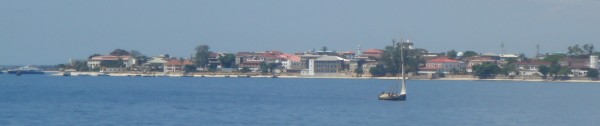
Another issue around producing qualified health workers lies at the pre-service level: Zanzibar consists of two islands, Unguja (to foreigners known as Zanzibar), and Pemba.

Unguja and Pemba off the East coast of Tanzania
Now the College of Health Sciences (located on Unguja), where we live and spend a lot of our time at work, trains students to become nurses, clinical officers, lab technicians, pharmacy technicians, environmental health officers and medical engineers.
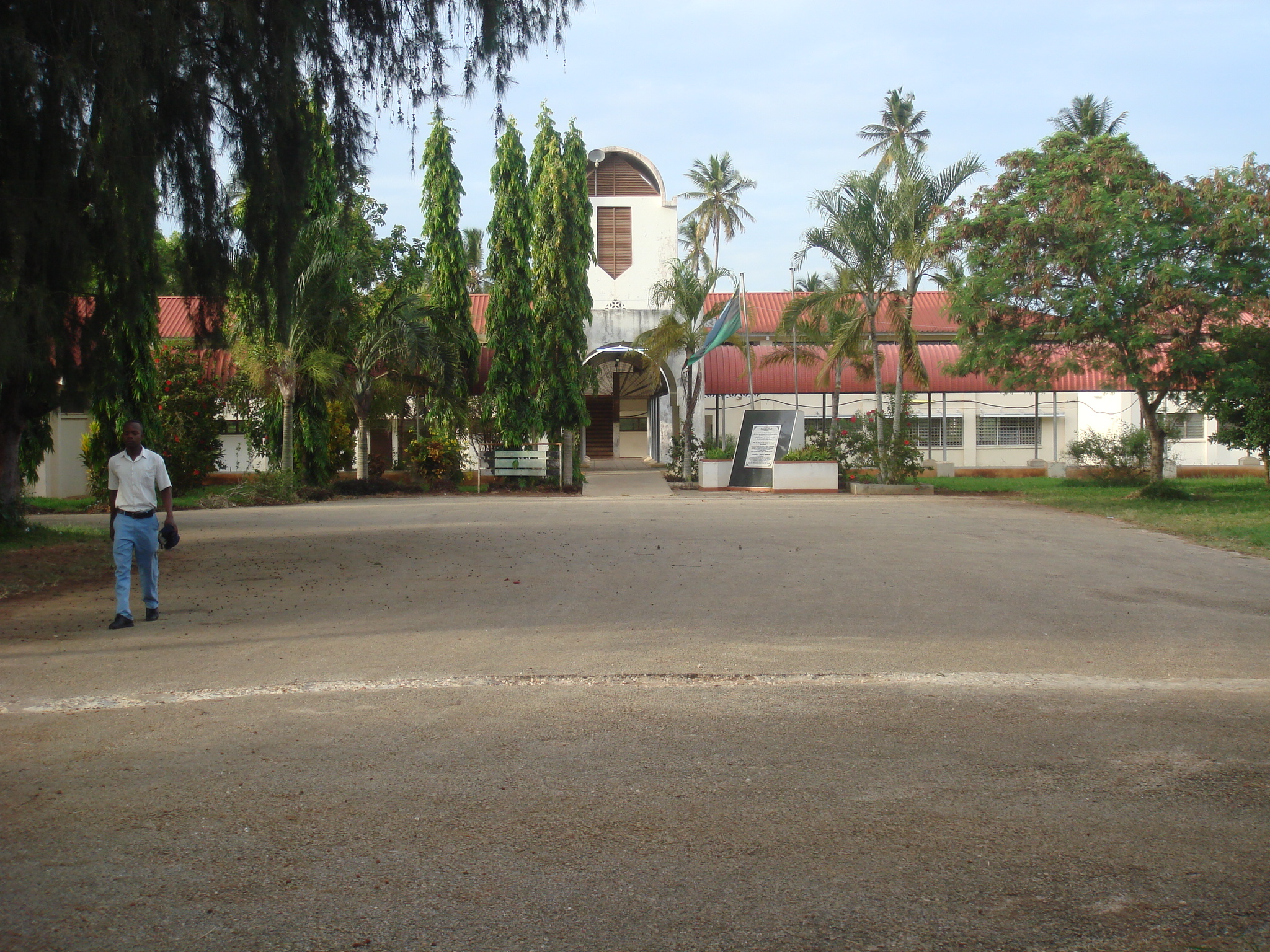
The College of Health Sciences
It’s the only vocational provider of this kind across Zanzibar, so many students come from the other island, Pemba. Hosting these students for 3 to 4 years is expensive for everyone involved and often has unwanted consequences: Since the quality of living and salaries are higher on Unguja than on Pemba many students do not return home to Pemba to work there, which leads to an eternal health worker shortage on the island. We are also told that many of the girls get married on Unguja and don’t end up working at all. You may now begin to see where e-learning enters the picture…..While we are not out here to be the destroyers of love matches and guards of borders, there are some clear and more non-disputable advantages in developing an e-learning offer at both pre-service and in-service level, revolving around costs, quality of materials, flexibility regarding learning hours, keeping staff on the job while learning. So it’s our job to further equip the College to become the e-learning hub and create small-scale e-learning centres for in-service training mainly in hospitals across the two islands.

With our IT colleague at the future resource centre in Kivunge hospital
John has just set up an e-learning structure in the format of a Moodle as a “one-stop shop” for all related materials which includes lesson plans, reference materials, quizzes, forums, chat functions, setting and uploading of assignments etc. Lecturers will also be able to record their voice to accompany PowerPoint presentations, to be accessed by students any time. We will be supporting the College in moving from a face-to-face methodology to a blended-learning approach (a mix of traditional face-to-face teaching and e-learning). The ambition is to help them become e-learning whizzes who can offer their knowledge as consultants to the mainland in the future, as e-learning is still a new thing in the health sector in Tanzania.
We’ll also be working with the hospitals to set up a robust structure that will allow staff to do effective learning on the job, including the use of tele-medicine for getting a second opinion on a diagnosis. We’re co-ordinating the acquisition of existing content regarding basic skills such as English and computer skills, and of health content to upgrade staff in the various professional fields.
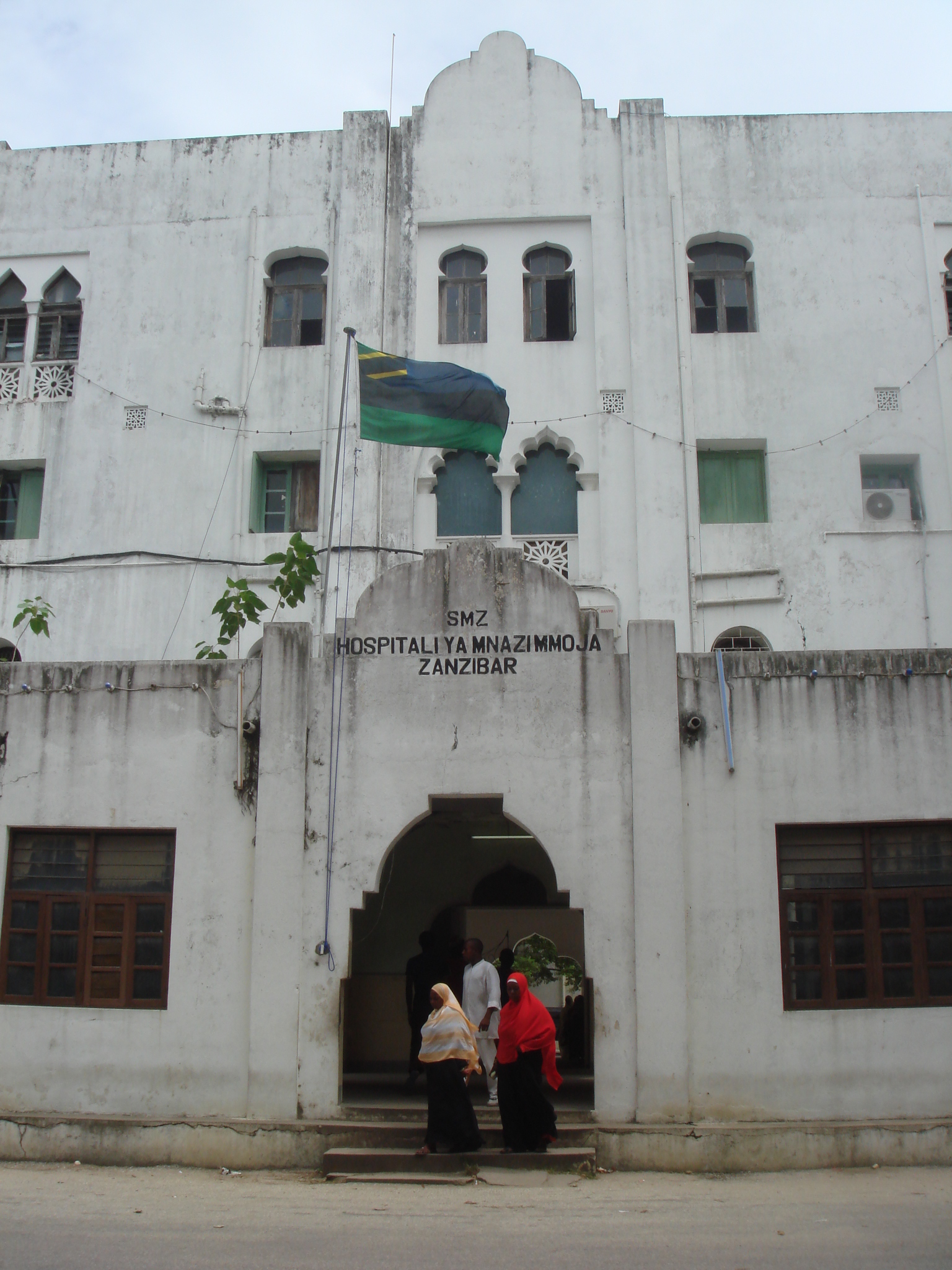
Mnazi Mmoja (“One Coconut Tree”) Hospital, the main hospital on Unguja
International partners are/will hopefully be for example WHO and AMREF, but also local Tanzanian organisations who have quality materials to offer, either in e-learning format or to be adapted to an e-learning context.
The focus areas are linked to Millennium Development Goals 4, 5 and 6 (http://web.undp.org/mdg/basics.shtml ): child and maternal health, HIV/AIDS, Malaria, immunology, non-communicable diseases and nutrition.
We have local counterparts at the College and the Ministry that we are already working with or will be working with in the future, when they are finally available, back in their job, returned from training elsewhere (quod erat demonstrandum, ey), to do capcacity building and ensure that the whole project doesn’t fall down but is in capable hands and can be sustained when we leave the country; one of, if not the greatest challenge in development work.
And then there are things in the periphery that have come up, electronic record keeping of patient data in hospitals, a database on in-service training delivered and required, a learning and development strategy for College staff etc. that we are or will be dipping into. Our work is diverse and there’s so loads to learn and hopefully a bit to contribute.
But this was just a first general overview for you after just under 3 months on the job. More details to follow in future posts, about successes and challenges, of which there are a few…
 najonajo
Good stuff! How’s the connectivity?
As you might expect, both power and connectivity are a real issue. Just to give an example: Lucky us, we’re running on the College’s generator right now. Yet again there is an unannounced longish power cut. About 6 times a week there are standard power cuts of 75 minutes in the evening – and the generator is never turned on during this time, during the unannounced cuts it’s on and off. Similar situation in the hospitals.
The bandwidth at the College is at 1 MB for 800 USD a month (this institution caters for 1000 students!!)…. But there is light at the end of the tunnel, a big government project to improve connectivity. When it will come? Soonish, inshallah…. 😉
I’ll leave it to John to do a little nerdy techy post on all his ingenious work-arounds (explanations of which I just nod to and smile cause as you know I wouldn’t be able to pass judgement… :-))
Thanks, interesting! Wow, 800 $ a month for 1 MB….I guess it all takes some serious pioneer spirit. We were without Internet in the office for 2 days last week and nearly freaked, what with deadlines (LRE :)) and all those cloud based apps…you’ve just put it all into perspective 🙂 Good luck!