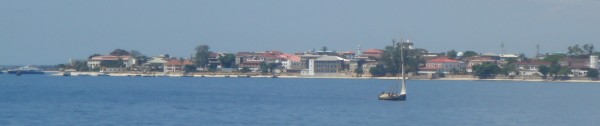
Hi everyone, it’s been a while, I know but I trust John has been keeping you entertained.
Thinking back I’ve just remembered I had my first Kiswahili lesson on our honeymoon. John and I were walking along a deserted, rather breezy beach on the Baltic coast in Northern Germany last December. Making use of one of the few sunny spells during our 3-day stay up there we wrapped ourselves uo and strolled along the coast and John taught me the words he already knew. John being John he’d managed to get himself a book and started learning as soon as our placement in Zanzibar was confirmed – that was in mid November, a frantic time, two weeks before our wedding and ten weeks before abandoning our home and departing for Tanzania!
It is amazing how as soon as you start learning Kiswahili you either just learn phrases and their rough meanings without understanding what you are actually saying, or you dive straight into the intricacies of the language, both grammatically and culturally speaking: “Hujambo” is generally translated as “How are you?”, but actually it means: “You do not have a problem? “ The answer is “Sijambo” – “I do not have a problem”. (The dumbed down tourist version is “jambo” only, for question and reply). Already an interesting concept that the absence of problems equates to being well. “Poa” – “cool” (as in a low temperature), is also used regularly as an answer and describes a state of well-being, since a low temperature is something very rare and welcome here. If you have been ill and people are inquiring about you, you say “nimeshapoa” – “I have already cooled down” no matter what the illness might have been doing to you. “Mzima?” – Mzima!” is another good one: An elliptic way of saying “Do you feel complete, whole?” – “Yes, I feel complete”.
There are by the way 159 ways of greeting your colleagues and neighbours and you must use at least 13 of them to have made a polite conversation during your first encounter of the day. My favourite one for the morning: “Umeamka!!?”– “You have a awoken!?” Still not entirely sure what the standard reply is, but I think it is “Ndiyo, nimeamka salama” – “Indeed, I have awoken peacefully.” Nice, eh?
Kiswahili (“the language of the coast”) is spoken as a lingua franca in many East African countries, but it actually originates from Zanzibar, where there are no regional languages and Kiswahili is therefore spoken in the home. We are told that because of this the Kiswahili we are learning here is “ the purest”, that means the complex grammar is adhered to more meticulously, the language is more embellished and a greater variety of vocabulary is used than in other countries. Thanks very much…
Kiswahili is an agglutinative language, that means an entire sentence like “she has not received it yet” can be contained in a single word – “Hajaipokea”. Obviously that means that nearly every little sound you hear bears an important meaning and you have to listen really carefully, especially as people tend to speak horribly quickly. Also tricky: The verb stem is at the end, not the beginning. So here we are, slowly constructing syllable by syllable laden with meaning, trying not to put our counterparts to sleep while we’re cobbling our words together. Ahhh!
7 different noun classes which entail learning different forms for personal pronouns, possessive pronouns, demonstrative pronouns, adjectives, the preposition “of” etc. also keep us on our toes.
Another interesting novelty for us: You have a different verb for “kuwa” – “to be”, when places are involved. So you don’t use the same verb for “He is a teacher” – “Yeye ni mwalimu” as for “He is in town” – “Yuko mjini”. Also, you differentiate whether someone is somewhere in an area, thereabouts, “yuko”, in a specified place “yupo”, or inside somewhere or something “yumo”.
But then for example there is no differentiation between the word “still” and “not yet” – both are “bado”. Still haven’t made my mind up on whether I agree with the logic behind that one …
Despite the difficulties around learning to communicate we are beginning to get into it, slowly but surely. We’ve also taken up lessons again since we got so frustrated over still not being able to understand what people are saying beyond small talk, and missing out on interesting conversations even though we’d been conscientiously pouring over our books.

Our constant companions
But of course there is English, which helps us do our work but does not help with learning Kiswahili much – officially the second language, the language of instruction in schools, at university and at court. But that certainly does not mean that everyone actually speaks the language. Even in our work at tertiary and Ministry level, where English is used on a daily basis for official communication we are surprised by people’s English language skills. There is no comparison to the English Kenyans for example speak. While Zanzibaris at a certain professional level are quite relaxed about using the language, their level of accuracy would actually make the vast majority elementary learners – which is why probably not only College students are interested in the online courses we are now offering on the Health Learning Management System we’ve set up.
Even the English – Kiswahili dictionary we were given by VSO is a bit of a surprise: I sit and read and wonder about the English idioms they come up with. And unfortunately, even though we have Edition 3, there are many big fat howlers in there: The entry for “land” is followed by the entry for “lady” (?), and we learn that there are “lady-locked countries”. And have you come across the word “posomethingumous”? Hm. Perhaps “sth” sometimes means something else…
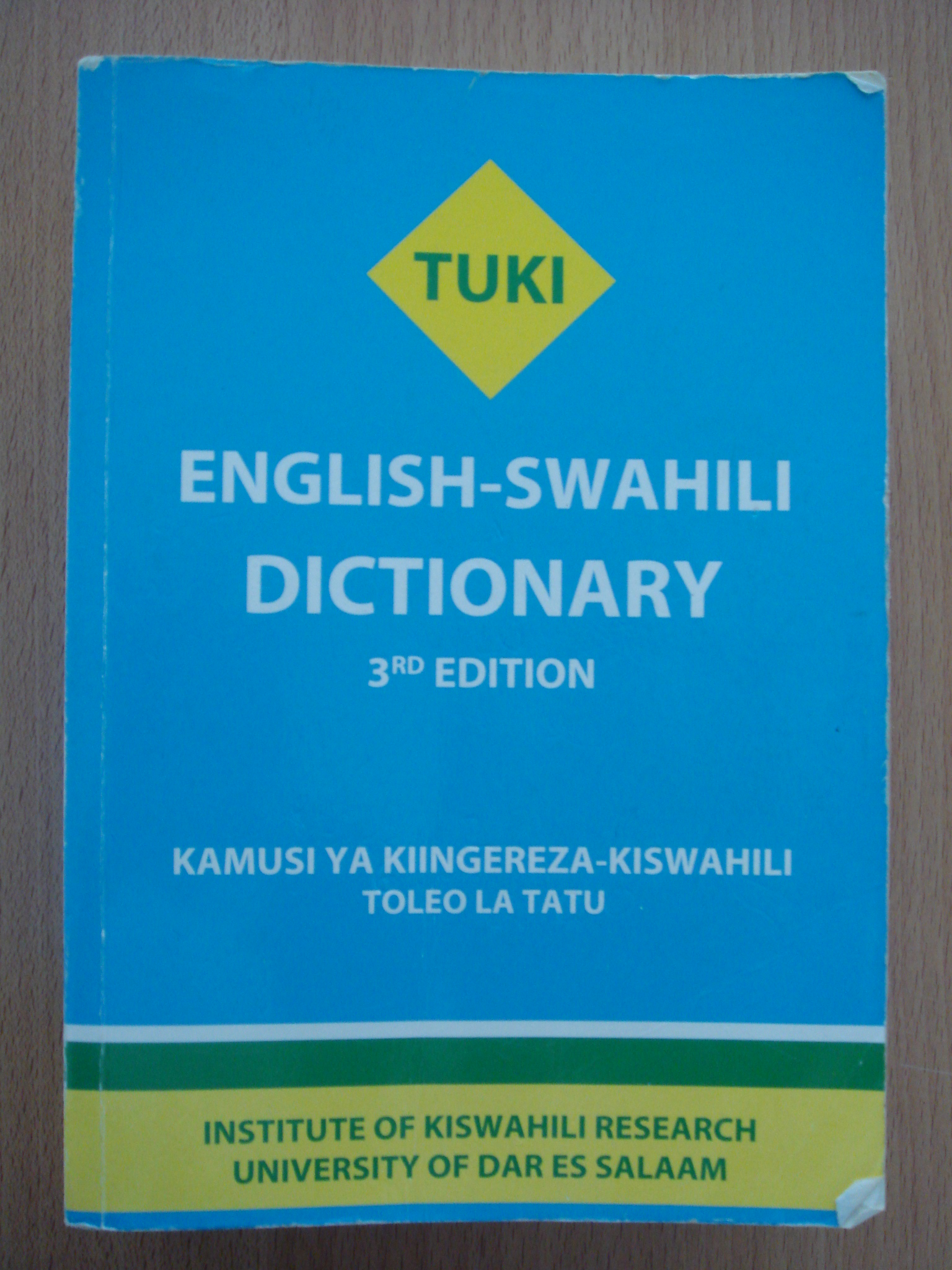
NOT a constant companion
Many English words have made it into Kiswahili though, which due to its colonial history and its traditional status of a language of trade in the region is a mix of Bantu languages, Arabic, Portuguese, some German, some Hindi, and English. (We’ve also found some traces of Bahasa Indonesia). Take an English word, write it as you pronounce it as a Kiswahili speaker and where possible add an “i” at the end, always put the emphasis on the penultimate syllable, and you have your kiswahili word. So “shirt” becomes “shati”, to order is “ku-oda”. But there are also other good ones: Best guess for what a roundabout is in Kiswahili? Is it: “Sacula”, “Nevastopi” or “Keepilefti”? I swear, it really is one of these three.
There is of course much more to say about Kiswahili, but let’s leave that for another time. This afternoon, if we can get our act together, we’ll be off to the beach for a bit of sun and some reading in our Kiswahili text books – it’s just that bit more comfortable than a beach in the Baltic in mid winter…
************************
And finally, to add to some boring pictures of books, a photo of cheeky and delightful Hosseini, our favourite 4-year old neighbour after having pestered us for a balloon that goes with the colour of his shirt.
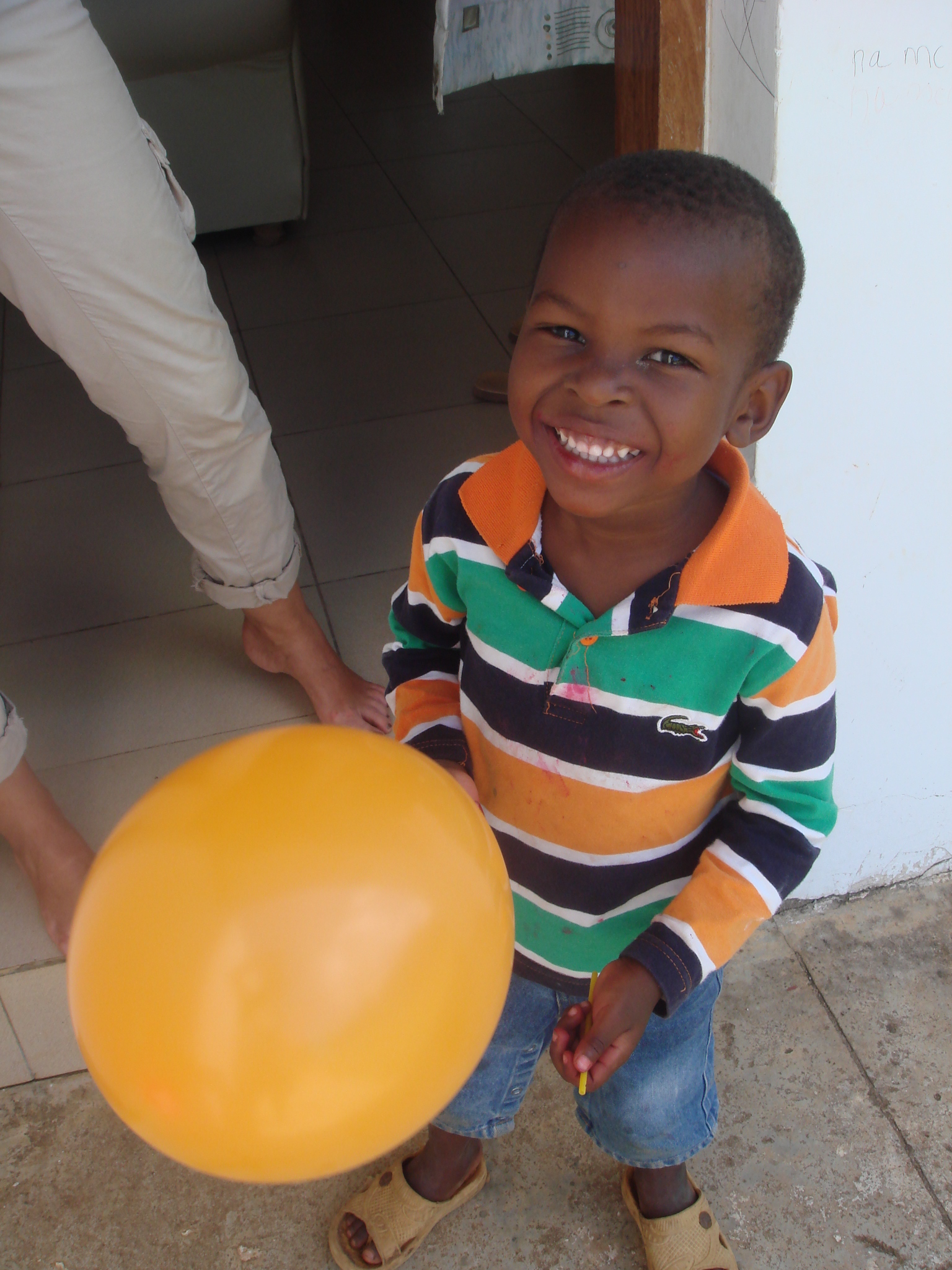
Clearly the best Kiswahili speaker amongst the three of us
 najonajo
Jeez! Makes learning German seem really quite easy!! Any update on what a lady-locked country is???? 🙂
We are told Kiswahili gets easier once you get over the first hurdles so I think German might after all still be the tougher one. Aber ich hab ja Deutsch nicht als Fremdsprache lernen müssen, deshalb ist es schwer einzuschätzen. John kann dazu wahrscheinlich mehr sagen.
Lady-locked? Sounds intriguing, or possibly quite scary, doesn’t it. Well, they did get the alphabetical order of “land” and “lady” wrong, and I understood enough of the kiswahili translation to see that it was talking about the lack of a coast, so quite a boring explanation I’m afraid…
It’s what Thatcher did to the UK in the 80s.
Not many people realize this but Geordie is also a very complex agglutinated language. Some examples:
“I don’t understand what you are saying, please repeat it again for me” – eh
“I’m not too sure what you’re talking about” – hadawayman
“Sorry, but you’re completely wrong” – yatakinshiteman
“Please pass the hammer quickly to me” – hoythahammaowahia
In fact on many occasions, I simply have to revert to Geordie and most Zanzibaris will understand perfectly what I’m saying. I have had many a philosophical argument with all manner of locals conducted entirely in Geordie / Kiswahili. After the sixth pint we’re often conversing like long lost brethren. Perhaps. . . Geordie is some kind of Afro-Caribbean niche language. It could be an important lingusitic link in the human ancestral chain. Perhaps our African ancestors didn’t migrate out of Africa through Arabia and up through Mesopotamia but hopped on the South Shields Ferry and went to Byker? I could be on to something.
You’ll find that in teenage boys, too:) In the mornings they tend to revert to stone-age grunts only as well. ( btw Vincent still remembers you, John, by that silly joke where you knocked on your head and the chair simultaneously….you made a lasting impression there) I do like nevastopi a lot, I must say!
John would probably say that behaviourally speaking I have remained at the level of a teenaged boy. So for me doing all the friendly greeting rigmarole 15 times in a row on the way to work (3 minutes, but passing by the always frequented mosque) comes as quite a chore at 7:30 in the morning….
And glad you like nevastopi but the right answer is keepilefti!
I’ve another cracking one that uses a ball of string and my left nostril. But I have to lie down for a week after doing it so it’s a bit of a rare one.